Bamboo-based Livelihood
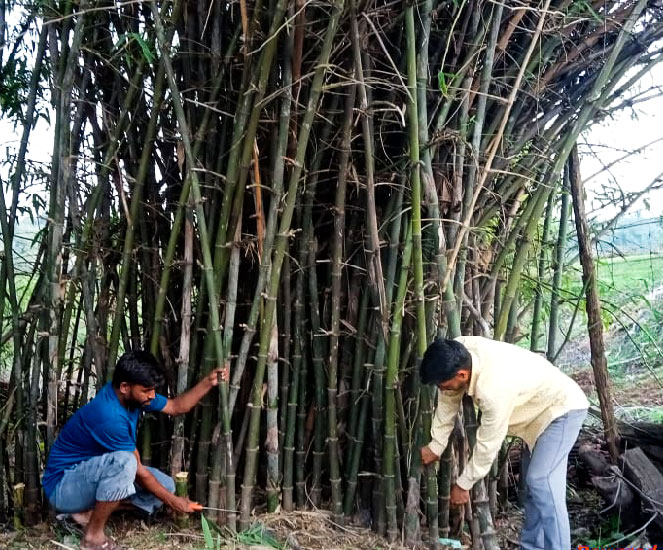
For Adivasi communities living near forests, bamboo has always been part of everyday life. It is used to make baskets, rainwear, fishnets, storage containers, compound walls, and other household items. Scattered bamboo plants around homes and farms have traditionally supported these needs.
In recent years, bamboo has gained new significance as a sustainable, eco-friendly alternative to plastic. This growing interest opens up economic opportunities for small and marginal Adivasi farmers, provided the existing bamboo around their fields is harvested and marketed systematically.
Recognising this potential, Pragati Abhiyan, in collaboration with the Maharashtra Bamboo Promotion Foundation, is implementing a bamboo-based livelihood initiative in partnership with eight Farmer Producer Organisations (FPOs) located in the Adivasi-dominated blocks of Nashik district. This ongoing project aims to unlock the economic potential of scattered bamboo by enabling its sustainable harvesting and trade through local FPOs. It is grounded in the belief that bamboo can serve as a valuable supplementary income source for small and marginal farmers when supported by strong institutional mechanisms.
The initiative focuses on training bamboo cutters and local youth—referred to as Bamboo Mitras—in scientific harvesting techniques, while facilitating the aggregation and sale of mature bamboo through the FPOs. A large-scale mapping exercise, carried out using the KOBO Collect app, is underway to document the availability of bamboo, clump types, and farmers’ current practices across the region.
To support field operations, essential tools such as secateurs, axes, sickles, and gloves have been distributed to participating FPOs. Working capital has been directly transferred to their accounts to facilitate bamboo procurement, pay harvesters, and establish local depots. In addition, a district-level Bamboo Project Committee has been formed to strengthen coordination, resolve field-level challenges, and promote peer learning through monthly meetings attended by FPO CEOs and directors.
The intervention has already led to a major milestone: the first-ever commercial sale of bamboo by these FPOs. For many of the participating farmers, this marked their first income from bamboo planted years ago. The trade—focused primarily on the Manvel and Katang varieties—was facilitated by FPOs and sold to traders supplying bamboo for agricultural use. This early success has boosted the confidence of the FPOs and reaffirmed the feasibility of collective marketing and enterprise-led bamboo value chains.
As the project progresses, attention is being paid to expanding outreach, understanding farmer preferences around bamboo sales, and encouraging new shareholder participation in the FPOs. The initiative demonstrates that with the right blend of training, financial support, tools, and institutional collaboration, bamboo can evolve into a sustainable livelihood option for tribal communities in the region.