Grain Processing Units
As the Nagali project advanced, post-harvest issues came into focus, especially threshing, cleaning, and processing. Since most families used Nagali for home consumption, they managed these tasks themselves. Earlier, women spent long hours threshing by hand. Later, motorcycles and tractors were used, but cleaning remained manual and tiring. The work was hard and time-consuming.
Threshing machines were available for major crops but not for minor millets like Nagali. When we looked for suitable machines, we realised how rare they were. In the first phase, we sourced a few portable single-phase threshers from Ludhiana and Coimbatore. These were easy to use in low-power villages and could be shared across locations. We bought six such threshers. Their use reduced grain loss and saved women’s time and effort. The leftover husk served as fodder.
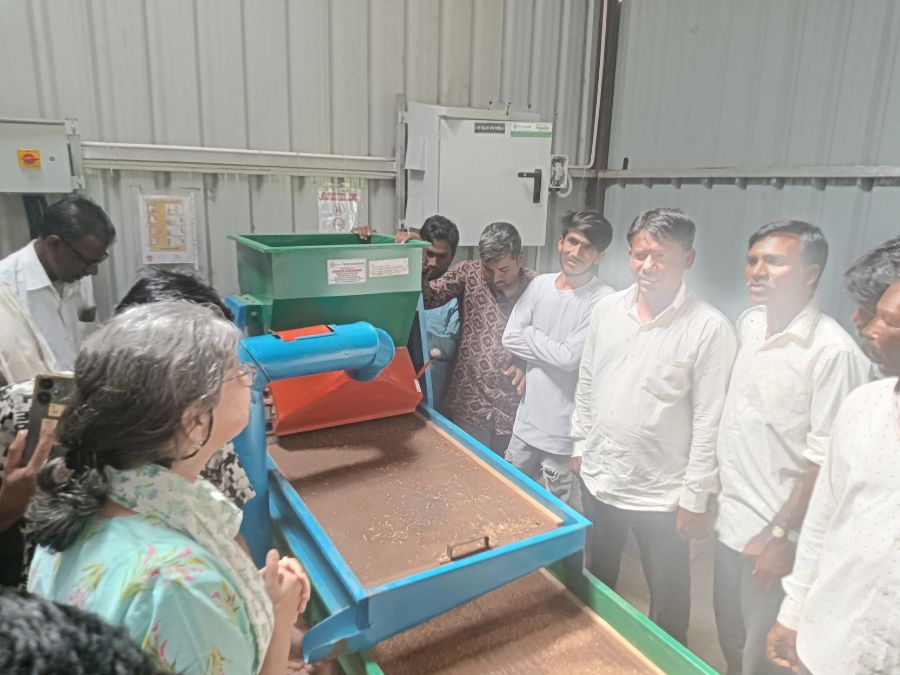
This experience led us to set up full-scale grain processing centres. These centres included machines for threshing, cleaning, sorting, grading, and pulverising. They helped improve the quality of grain for market sale. Millet Mentor CSO (under the RRA Network and WASSAN) supported us in selecting the right machinery and layout.
We partnered with Pabal Ashram, a vocational school that trains students in machinery and fabrication. Their students and FPO members built the sheds themselves, without contractors. This ensured all the money went into actual construction.
Electricity was a challenge. Selco Foundation stepped in with solar-powered solutions. Now, all machines run on solar energy.These centres are managed by three Farmer Producer Organisations (FPOs), one each in Trimbakeshwar, Peth, and Surgana. They now operate the centres independently and are building them into viable local enterprises.